
Ported Cube
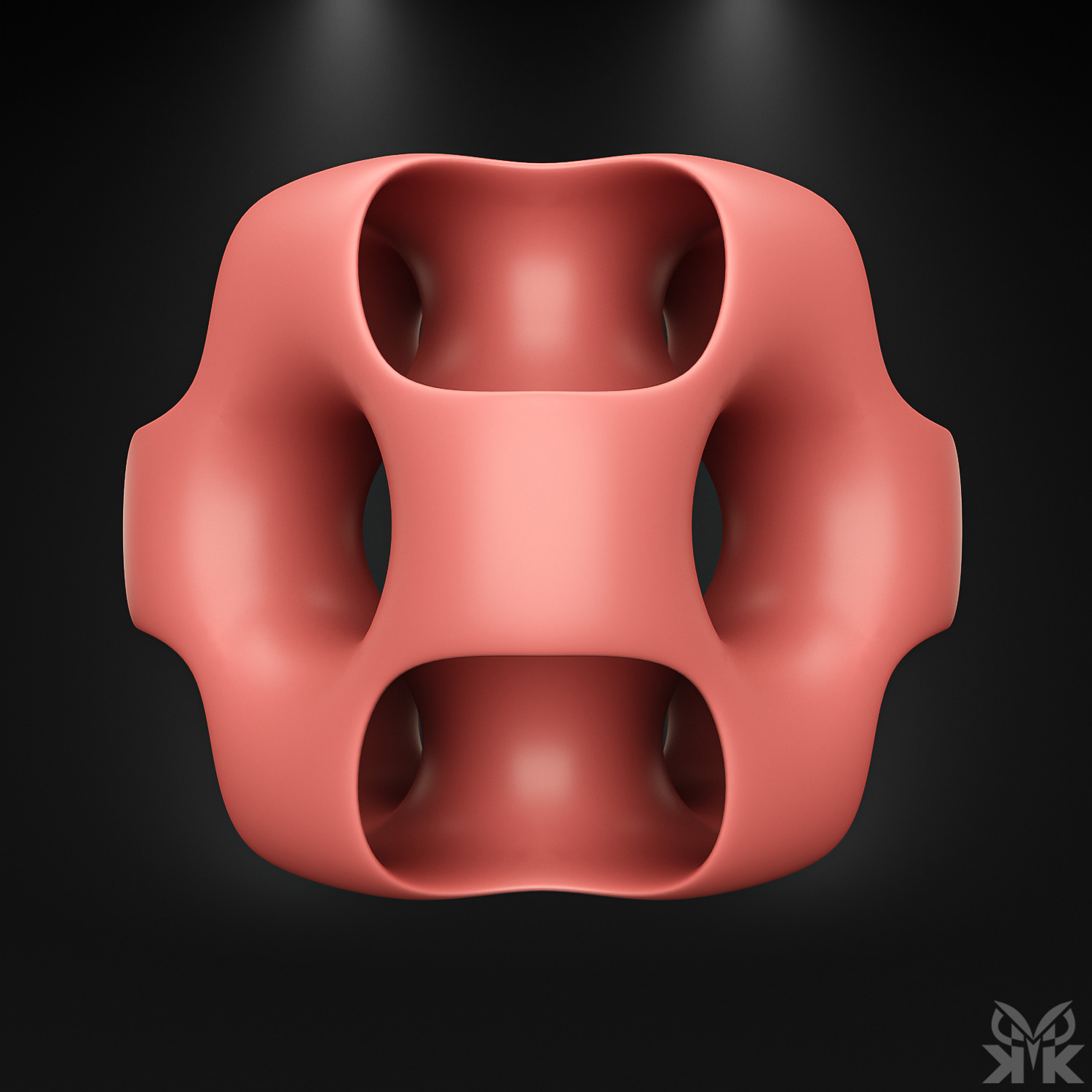
Ported Cube
Modeled in: 3ds Max | Unwrapped & Rendered in: 3ds Max | Source: Tutorial Study Based on John Malcolm (Luxxeon 3D)
This 3D model explores a cubic form transformed through the integration of large geometric voids and smooth transitional surfaces. Developed entirely in 3ds Max following a tutorial by John Malcolm of Luxxeon 3D, the project focuses on spatial subtraction, surface continuity, and the relationship between positive and negative space within a simplified geometric structure.
Particular attention was given to curvature flow, edge blending, proportional balance, structural symmetry, and the interaction between external volume and internal cavities. The study investigates how simple geometric primitives can evolve into visually dynamic forms while maintaining clarity, cohesion, and geometric harmony.
The clay presentation highlights form development, geometric precision, and surface continuity without the influence of materials, reflections, or textures. By focusing exclusively on geometry, the model’s sculptural construction, internal volumes, and overall silhouette remain the primary focus of the study.
Original tutorial concept and design belong to John Malcolm (Luxxeon 3D) and their respective rights holders.
3D modeling study, interpretation, and visualization by Kemal Korkmaz.
Related Keywords
Ported Cube, John Malcolm, Luxxeon 3D, Cubic Form Study, Geometric Sculpture, Abstract Geometry, Negative Space Design, Surface Modeling, Form Study, Hard Surface Modeling, 3ds Max, Geometry Study, Computational Design, Digital Sculpture, CGI, Digital Art, Clay Render, 3D Modeling, Visualization, Concept Modeling, Product Design, Geometric Design, Topology Study, Work In Progress, WIP










No Comments